

Longitudinal Profile Of A Stream
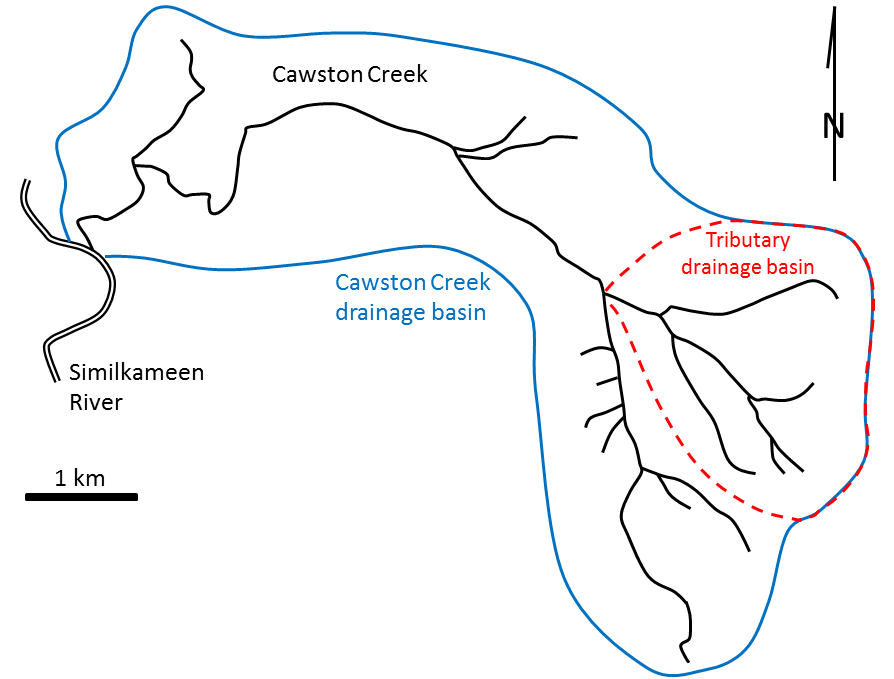 Figure 1. Cawston Creek nearly Keremeos, B.C. The blue line shows the extent of the drainage basin. The dashed red line is the drainage basin of ane of its tributaries. [SE]
A stream is a trunk of flowing surface water of whatever size, ranging from a tiny trickle to a mighty river. The area from which the h2o flows down to class a stream is known as its drainage bowl. Sometimes it is as well calledwatershed or watershed basin. All of the precipitation (pelting or snow) that falls within a drainage basin somewhen flows into its stream, unless some of that water is able to cross into an adjacent drainage basin via groundwater flow. An example of a drainage basin is shown in Figure one.Stream network within a specific drainage basin is called adrainage network.
The drainage area of a stream encompasses all the land from which surface runoff flows into that stream. Boundaries between stream drainage areas are called drainage divides. Below is computer based rendering of the digital elevation model(nighttime brown colors - loftier elevations, light-green - low elevations) and watershed basin (in green).
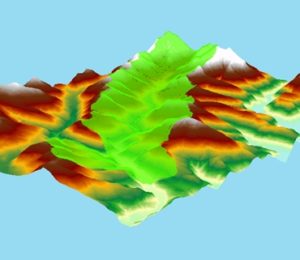
See instance of the Lake Champlain Bowl Atlas Watershed Areas and Tributaries:
http://atlas.lcbp.org/nature-surround/watersheds-and-tributaries/
Drainage Basin Patterns
The pattern of tributaries within a drainage basin depends largely on the blazon of rock beneath, and on structures inside that rock (folds, fractures, faults, etc.). The three main types of drainage patterns are illustrated in Figure 3. Dendritic patterns, which are past far the most common, develop in areas where the rock (or unconsolidated material) beneath the stream has no item fabric or construction and tin can be eroded as easily in all directions. Examples would be granite, gneiss, volcanic rock, and sedimentary rock that has non been folded. Most areas of British Columbia have dendritic patterns, as practice well-nigh areas of the prairies and the Canadian Shield. Trellis drainage patterns typically develop where sedimentary rocks accept been folded or tilted and then eroded to varying degrees depending on their forcefulness. The Rocky Mountains of B.C. and Alberta are a skillful example of this, and many of the drainage systems within the Rockies have trellis patterns. Rectangularpatterns develop in areas that have very trivial topography and a system of bedding planes, fractures, or faults that grade a rectangular network. Rectangular drainage patterns are rare in Canada.
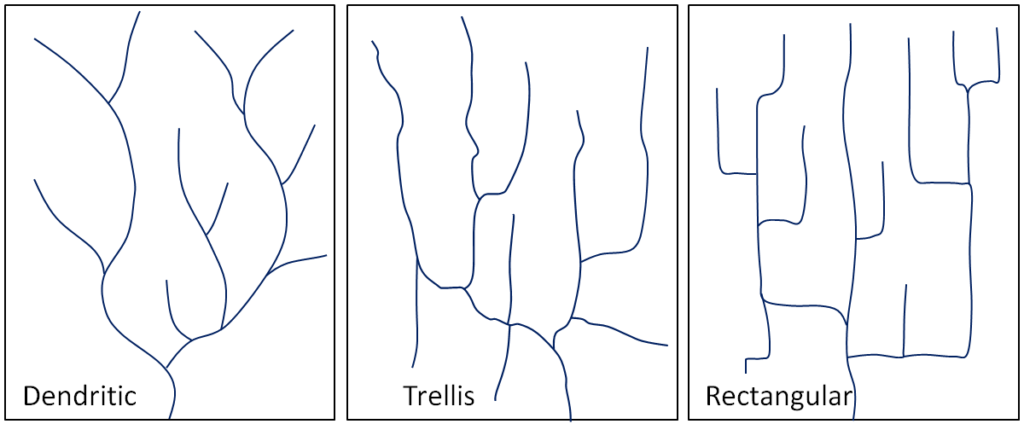 Figure three. Typical dendritic, trellis, and rectangular stream drainage patterns. [SE]
In many parts of Canada, peculiarly relatively flat areas with thick glacial sediments, and throughout much of Canadian Shield in eastern and central Canada, drainage patterns are cluttered, or what is known equally deranged(Effigy 4, left). Lakes and wetlands are common in this type of surroundings.A quaternary type of drainage pattern, which is non specific to a drainage bowl, is known as radial (Figure iv, correct). Radial patterns form around isolated mountains (such equally volcanoes) or hills, and the individual streams typically accept dendritic drainage patterns.
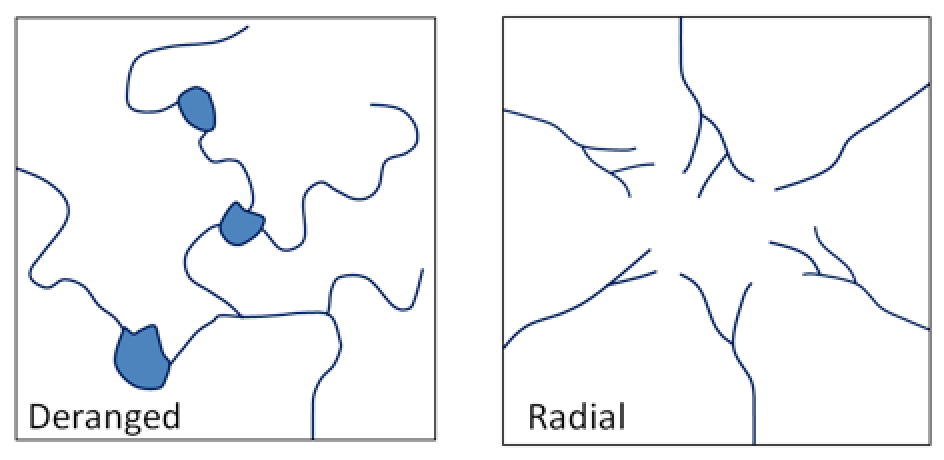 Figure 4. Left: a typical deranged blueprint; right: a typical radial drainage pattern developed around a mount or colina. [SE]
Stream Longitudinal Profiles
Longitudinal profiles are plots of the tiptop vs distance from the stream oral fissure to the upper reaches within watershed basin. They help to establish relationship between slope steepness and distance from the upper to lower reaches. Gradient or slope can be measured in degree or percentage (ascension over run). Below is an example of stream longitudinal profile for Cawston Creek.
Cawston Creek is a typical small-scale drainage basin (approximately 25 kmii) inside a very steep glaciated valley. Every bit shown in Figure 2, the upper and middle parts of the creek have steep gradients (averaging about 200 chiliad/km just ranging from 100 to 350 yard/km), and the lower part, inside the valley of the Similkameen River, is relatively flat (<five thou/km). The shape of the valley has been controlled first past tectonic uplift (related to plate convergence), then past pre-glacial stream erosion and mass wasting, then past several episodes of glacial erosion, and finally by post-glacial stream erosion. The everyman elevation of Cawston Creek (275 1000 at the Similkameen River) is its base level. Cawston Creek cannot erode beneath that level unless the Similkameen River erodes deeper into its flood plain (the expanse that is inundated during a alluvion).
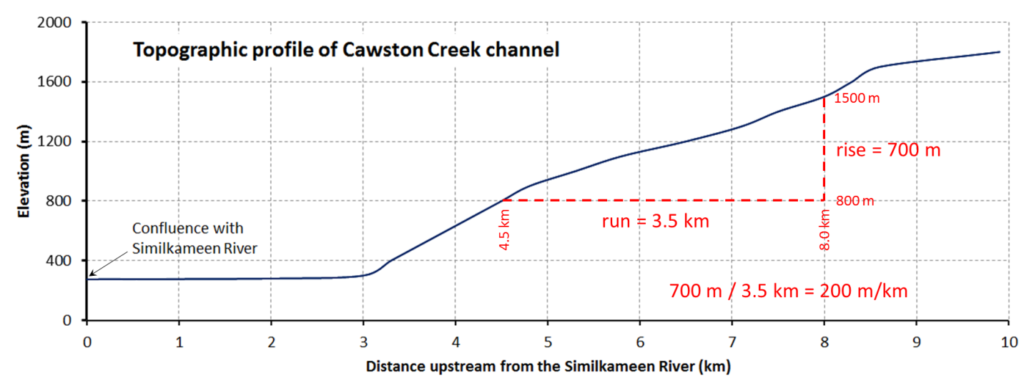 Figure 2. Profile of the main stem of Cawston Creek nigh Keremeos, B.C. The maximum summit of the drainage basin is virtually 1,840 thou, near Mount Kobau. The base level is 275 g, at the Similkameen River. As shown, the slope of the stream can exist adamant by dividing the change in top betwixt any 2 points (rise) by the altitude between those two points (run). [SE]
Cawston Creek profiles shows many levels of slope forth its profile. For example, at that place are unlike gradients between viii.4 and 10 km, 3 and five km. This means that surface erosion has not yet leveled or graded Cawston Creek; therefore it is calledungraded stream.
Over geological time, a stream will erode its drainage basin into a smooth profile similar to that shown in Figure 5. If we compare this with an ungraded stream like Cawston Creek (Figure i), we tin can see that graded streams are steepest in their headwaters and their gradient gradually decreases toward their mouths. Ungraded streams accept steep sections at various points, and typically take rapids and waterfalls at numerous locations along their lengths.
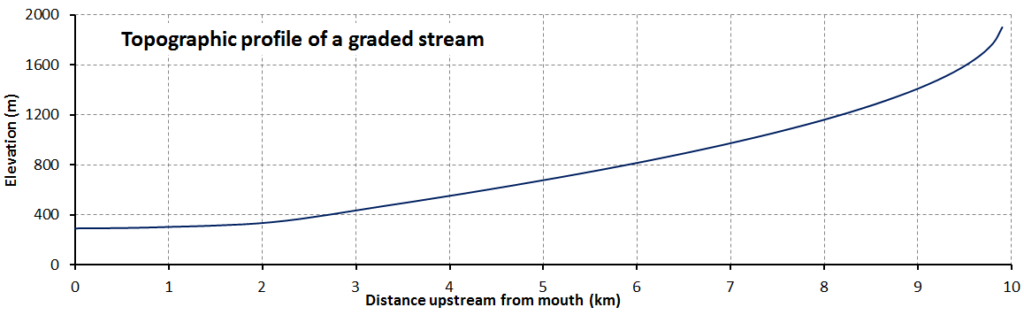 Figure v. The topographic profile of a typical graded stream. [SE]
Influence of Tectonic Movements on Streams
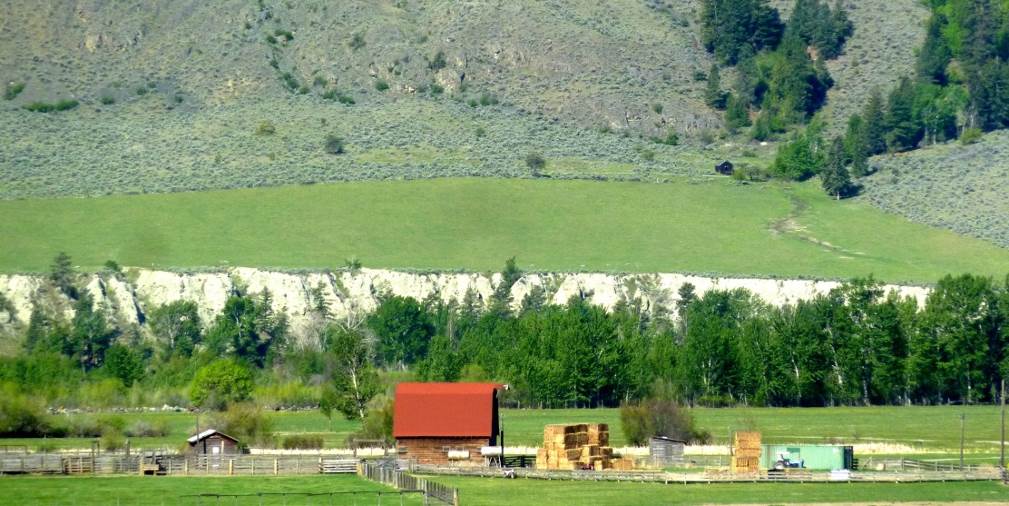 Figure vi. An example of a change in the base level of a small stream that flows into the Similkameen river about Keremeos. The previous base level was near the top of the sandy depository financial institution. The electric current base level is the river. [SE]
A graded stream tin become ungraded if there is renewed tectonic uplift, or if at that place is a alter in the base of operations level, either because of tectonic uplift or some other reason. Equally stated before, the base level of Cawston Creek is defined past the level of the Similkameen River, but this tin alter, and has done then in the past. Figure 6 shows the valley of the Similkameen River in the Keremeos surface area. The river aqueduct is just beyond the row of trees. The light-green field in the distance is underlain by material eroded from the hills behind and deposited by a small creek (not Cawston Creek) adjacent to the Similkameen River when its level was higher than it is at present. Sometime in the past several centuries, the Similkameen River eroded downward through these deposits (forming the steep depository financial institution on the other side of the river), and the base level of the small creek was lowered past about 10 m. Over the side by side few centuries, this creek will seek to become graded again by eroding downward through its own alluvial fan.
Another example of a change in base level can be seen along the Juan de Fuca Trail on southwestern Vancouver Island. As shown in Figure 7, many of the small streams forth this role of the coast flow into the sea as waterfalls. It is axiomatic that the land in this area has risen past well-nigh 5 g in the past few grand years, probably in response to deglaciation. The streams that used to flow directly into the ocean now have a lot of down-cutting to practice to go regraded.
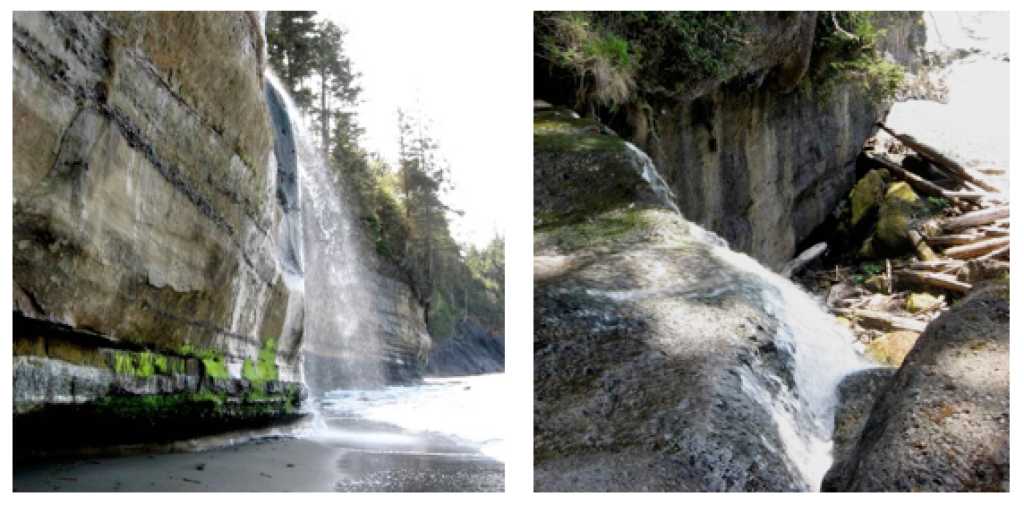 Figure seven. Two streams with a lowered base level on the Juan de Fuca Trail, southwestern Vancouver Island. [SE]
The body of water is the ultimate base of operations level, but lakes and other rivers human action as base levels for many smaller streams.
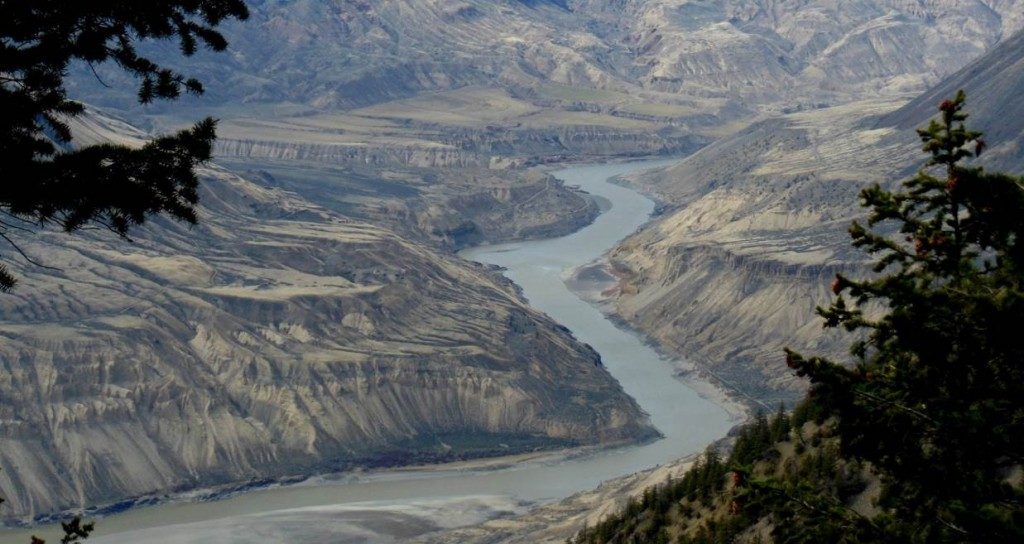 Figure 9. Terraces on the Fraser River at High Bar. [Marie Betcher photo, used with permission]
Sediments accumulate within the inundation plain of a stream, and and then, if the base level changes, or if there is less sediment to eolith, the stream may cut downwardly through those existing sediments to form terraces. A terrace on the Similkameen River is shown in Figure six and some on the Fraser River are shown in Figure 9. The Fraser River photo shows at least two levels of terraces.
In the tardily nineteenth century, American geologist William Davis proposed that streams and the surrounding terrain develop in a cycle of erosion (Figure ten). Following tectonic uplift, streams erode quickly, developing deep V-shaped valleys that tend to follow relatively straight paths. Gradients are loftier, and profiles are ungraded. Rapids and waterfalls are common. During the mature stage, streams erode wider valleys and showtime to deposit thick sediment layers. Gradients are slowly reduced and grading increases. In old historic period, streams are surrounded by rolling hills, and they occupy wide sediment-filled valleys. Meandering patterns are common.
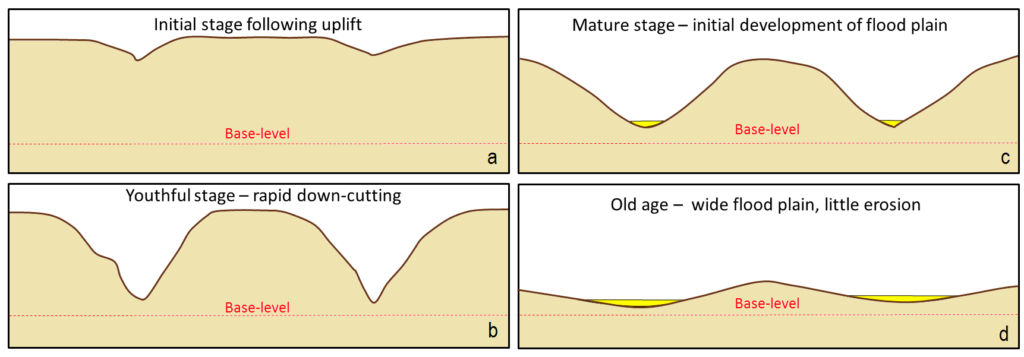 Figure 10. A depiction of the Davis cycle of erosion: a: initial stage, b: youthful stage, c: mature stage, and d: old age. [SE]
Davis'due south work was done long before the thought of plate tectonics, and he was non familiar with the impacts of glacial erosion on streams and their environments. While some parts of his theory are out of engagement, information technology is nonetheless a useful way to understand streams and their evolution.
Licenses and Attributions

Longitudinal Profile Of A Stream,
Source: https://www.coursehero.com/study-guides/cuny-lehman-geo/reading-drainage-basins/
Posted by: layherus1970.blogspot.com
0 Response to "Longitudinal Profile Of A Stream"
Post a Comment